
Why did Abdus Salam donate his Nobel Prize to AMU?
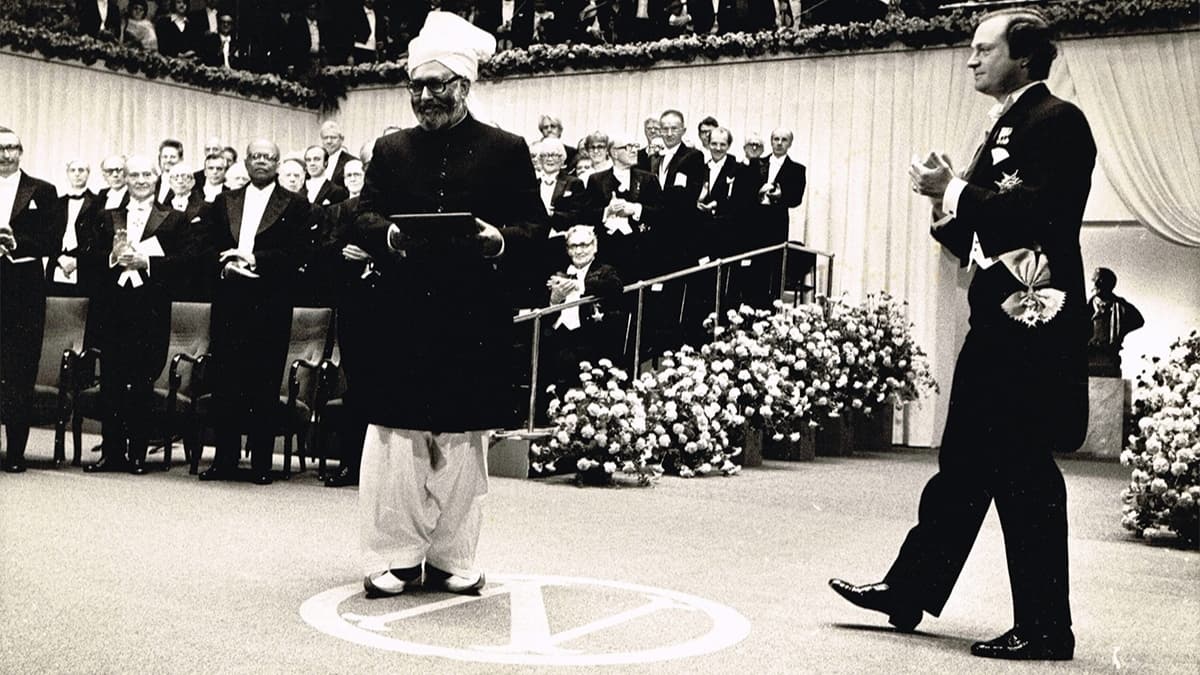
In December 1979, Pakistan got its first Nobel. Dr. Abdus Salam was awarded the Nobel Prize in Physics, along with Sheldon Glashow and Steven Weinberg, for their contribution to the theory of the unified weak and electromagnetic interaction between elementary particles, becoming the first Pakistani and the first Muslim Nobel laureate in science.
Born in Jhang and educated in Pakistan before completing his higher education at Cambridge, Abdus Salam belonged to the Ahmadiyya community, a community founded by Mirza Ghulam Ahmad of Qadian, who claimed to be the Promised Messiah and Mahdi. Ahmad’s claims became the subject of a long-standing theological dispute over the status of the Ahmadiyya community within Islam.
Theological Disputes and the 1974 Constitutional Amendment
This question did not go quiet with time. Even after the establishment of Pakistan, which was created with the protection of Muslim political and cultural interests as an important part of its historical background, the question of what it meant to be a Muslim remained contested. A country created especially for the political and cultural protection of Muslims in South Asia now had to define, constitutionally, what being a Muslim meant.
In 1974, during the prime ministership of Zulfikar Ali Bhutto, the Second Amendment to the Constitution of Pakistan was passed, constitutionally declaring Ahmadis to be non-Muslims and making them a constitutionally recognised religious minority.
After this, a large number of anti-Ahmadi riots and incidents of persecution were seen across the country. In the midst of this atmosphere, and as the situation became increasingly difficult for Ahmadis, Salam eventually left Pakistan and continued his scientific career abroad.
Aligarh Muslim University (AMU) Honours Dr. Abdus Salam
Aligarh was witnessing all this. Abdus Salam was honoured with an invitation to visit Aligarh Muslim University. When he reached AMU, thousands of students gathered to listen to his series of lectures in the Department of Physics.
Abdus Salam also made a substantial contribution to AMU. He was associated with the foundation ceremony of the Interdisciplinary Biotechnology Institute, and on 15 January 1986. Salam laid the foundation foundation of the institute.
Students’ Union coferred a Lifetime Membership on him. A photograph of him still graces the wall of the Union Hall.
Salam donated his Nobel Prize to Aligarh Muslim University as a gesture of gratitude, making it a symbol of scientific excellence preserved at Aligarh.
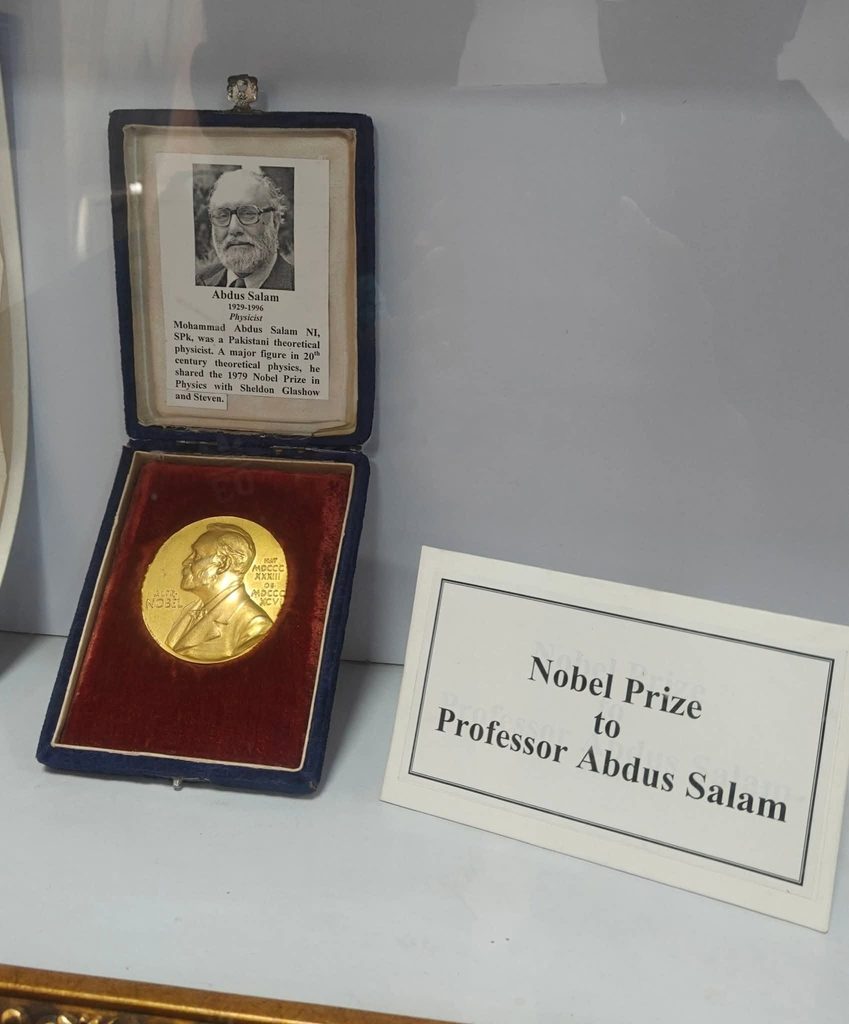
Nobel Prize of Abdus Salam at the Maulana Azad Library in Aligarh Muslim University
Tahzib-ul-Akhlaq and Abdus Salam
In January 1986, Tahzib-ul-Akhlaq published a special “Abdussalam Number”, dedicated to his ideas and writings. In one of his articles, he compared different technological developments and discussed the conditions of countries such as Pakistan, China and Japan, while reflecting on the importance of education, science and technological development.
Harmonizing Science, the Qur’an, and Sir Syed’s Vision
Abdus Salam was a man who always talked about the Qur’an in the light of science. Once, a boy asked him what his inspiration for the Nobel Prize was. He pointed towards the Qur’an resting on his shelf.
And, summing up his scientific quest, he said:
“Once research has reached the quark level, perhaps there is yet another step and yet another, until there will remain just one single stuff of which all matter is made.”
Salam’s quest was for unity, beauty and simplicity.
According to him around 750 verses of the Holy Qur’an, almost one-eighth of the Book, exhort believers to study nature and reflect upon its phenomena. So, for Salam, Islam was in no conflict with science.
Sir Syed was quoted multiple times in Salam’s writings in Tahzib-ul-Akhlaq, returning again and again to Sir Syed’s idea of the propagation of knowledge and scientific education.
For Salam, the pursuit of scientific knowledge was not something separate from the intellectual tradition of Islam; rather, he saw it as part of the same search for knowledge that Sir Syed had advocated decades earlier.
(The views and ideas expressed are personal to the author)


