Jawaharlal Nehru at 137: Remembering India’s First Prime Minister and His Vision of a Democratic, Secular India
Who Was Jawaharlal Nehru? The Architect of Modern India
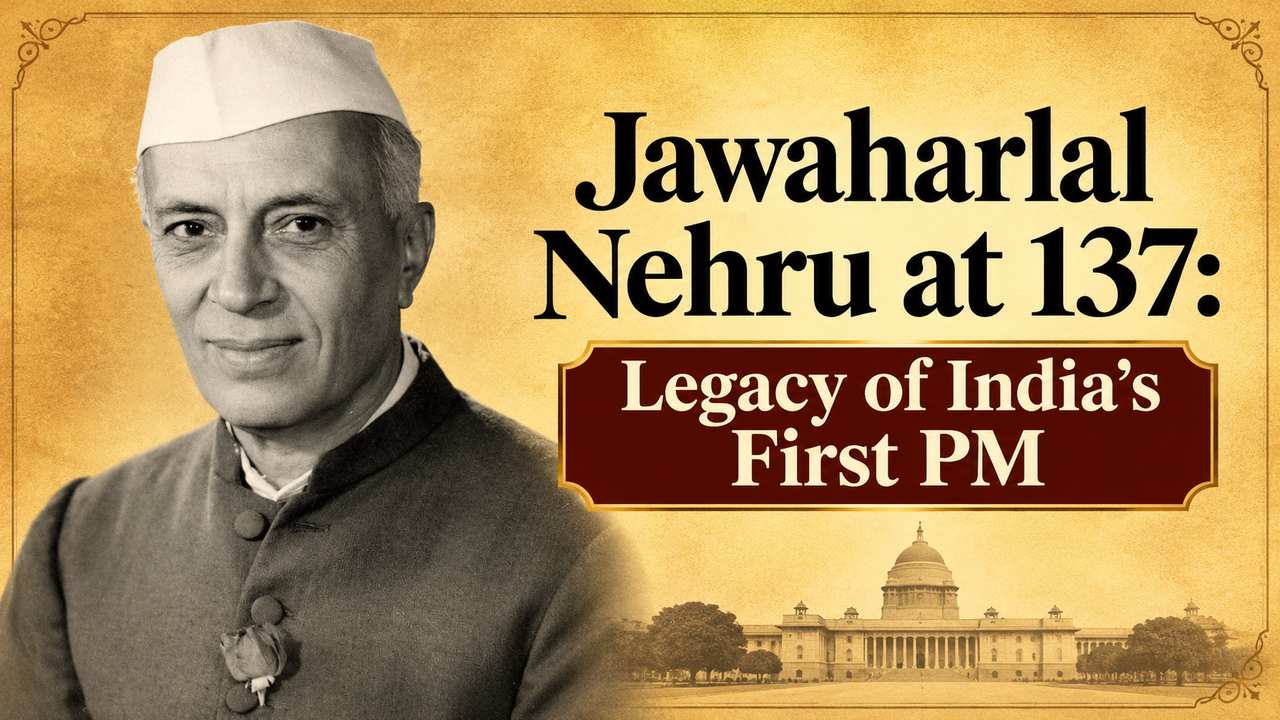
On 14 November 2026, India observes the 137th birth anniversary of Pandit Jawaharlal Nehru (14 November 1889-27 May 1964), the country’s first prime minister and one of the most influential architects of modern India.
Popularly remembered as Chacha Nehru, particularly for his affection for children, Nehru’s historical significance extends far beyond his association with children’s education. He was a freedom fighter, nationalist, internationalist, institution-builder and an advocate of scientific thinking, parliamentary democracy and secularism.
When India achieved independence on 15 August 1947, Nehru inherited a country facing extraordinary challenges. Partition had resulted in mass displacement, communal violence and the loss of countless lives. The economy was weak, industrial development was limited, literacy was extremely low, and poverty affected a substantial proportion of the population.
The newly independent nation also had to integrate hundreds of princely states, establish democratic institutions and determine its position in a world divided by the Cold War.
Nehru’s challenge was to transform political independence into a foundation for economic prosperity, social justice and national unity. His vision was that India should not become merely an independent geographical territory but a modern nation founded on constitutional democracy, religious pluralism, scientific advancement and equal citizenship.
As India remembers his 137th birth anniversary, it is important to examine his achievements critically, recognising both the institutions he established and the shortcomings of his policies. His contribution deserves historical assessment rather than political exaggeration or ideological dismissal.
Nehru and Parliamentary Democracy: India’s First General Election (1951–52)
One of Nehru’s greatest contributions was his commitment to parliamentary democracy at a time when several newly independent countries were moving towards military rule or authoritarian governments.
India’s first general election, held between October 1951 and March 1952, was a historic democratic experiment. According to the Election Commission of India, approximately 17.32 crore voters were registered, of whom around 45 percent were women.
Elections were conducted for 489 Lok Sabha seats over 68 polling days. The significance of this achievement becomes clearer when we remember that a large proportion of India’s population was illiterate and had little previous experience of democratic elections.
Nehru strongly supported universal adult suffrage, allowing citizens to exercise their voting rights irrespective of wealth, caste, religion, gender or educational qualifications. He also personally campaigned across the country.
According to President Pranab Mukherjee’s 2014 memorial lecture, Nehru travelled approximately 25,000 miles and addressed nearly 35 million people during the first general election campaign.
Nehru’s commitment to parliamentary institutions helped establish a democratic tradition in which governments could be challenged, criticised and replaced through elections.
However, his democratic record was not without contradictions. The dismissal of Kerala’s elected Communist government in 1959 and the use of preventive detention raised questions about executive power. His government also introduced the First Constitutional Amendment in 1951, which affected certain freedoms of expression.
Nevertheless, the continuation of competitive elections and parliamentary government under his leadership was a major achievement in India’s early democratic history.
Nehru’s Economic Planning: Five-Year Plans, Mixed Economy and Steel Plants
Nehru believed that political independence without economic transformation would have limited meaning. India inherited an economy characterised by poverty, agricultural dependence, weak industrial infrastructure and limited technological capabilities.
To address these problems, the Planning Commission was established in March 1950. Nehru supported a mixed economy in which the public sector would develop strategic industries while private enterprise would continue to operate in other sectors.
The First Five-Year Plan (1951-56) concentrated on agriculture, irrigation, power generation and rural development. The Second Five-Year Plan (1956-61), influenced by economist P.C. Mahalanobis, emphasised heavy industries and capital goods.
Three important steel plants symbolised this industrial ambition:
- Bhilai Steel Plant, established with Soviet assistance.
- Rourkela Steel Plant, established with West German assistance.
- Durgapur Steel Plant, established with British assistance.
These industries provided the foundations for India’s engineering, manufacturing, construction and infrastructure sectors.
Nehru understood that a country dependent entirely on imported machinery could not achieve genuine economic sovereignty. His industrial strategy therefore aimed to develop domestic productive capacity. The results were significant, although uneven.
The Second Plan experienced pressures from foreign exchange shortages, inflation and resource constraints. The industrial licensing system also created bureaucratic complications that later restricted competition and entrepreneurship.
India did not become a prosperous industrial economy during Nehru’s lifetime, but the foundations of its modern industrial structure were substantially strengthened during his premiership.
Nehru’s “Temples of Modern India”: Dams, Agriculture and Infrastructure
Nehru considered agricultural development essential to national prosperity. At independence, India faced food shortages, inadequate irrigation, low agricultural productivity and dependence on unpredictable monsoon rainfall.
His government invested in multipurpose river valley projects that combined irrigation, electricity generation and flood management. Important examples included the Bhakra-Nangal Project, Damodar Valley Corporation and Hirakud Dam.
These projects supported agricultural expansion, industrial development and electricity generation.
Nehru famously described large dams as the “temples of modern India”. This statement reflected his belief that modern engineering and scientific infrastructure could transform the lives of ordinary citizens.
Land reforms, including the abolition of zamindari in several states, also attempted to reduce traditional inequalities in land ownership. However, implementation varied considerably across states.
It is important to distinguish Nehru’s agricultural achievements from the Green Revolution, which developed primarily after his death. The Green Revolution’s major expansion took place during the mid-1960s and 1970s.
Nehru’s contribution was principally the creation of an institutional and infrastructural foundation for subsequent agricultural modernisation.
Nehru’s Contribution to Science and Education: IITs, AIIMS and Scientific Temper
Nehru believed that scientific education and technological development were indispensable to India’s future. He understood that political freedom alone could not eliminate poverty and backwardness unless India developed its own scientific and technical capabilities.
His government supported the establishment and expansion of major institutions, including:
IIT Kharagpur (1951), IIT Bombay (1958), IIT Madras (1959), IIT Kanpur (1959), IIT Delhi (1961), All India Institute of Medical Sciences (AIIMS), 1956 and University Grants Commission (UGC), 1956.
The establishment of the Department of Atomic Energy in 1954, under the leadership of Homi J. Bhabha, was another major step toward developing India’s technological independence.
Nehru also supported scientific laboratories and research institutions under the Council of Scientific and Industrial Research. His idea of scientific temper was not restricted to laboratories. He wanted Indian society to develop rational thinking, critical inquiry and an evidence-based approach to social and political problems.
However, his educational policy had limitations. India’s primary education system remained underdeveloped, and access to schooling was highly unequal.
According to government literacy statistics, literacy among people aged seven and above increased from 18.33 per cent in 1951 to 28.30 per cent in 1961. Female literacy increased from 8.86 per cent to 15.35 percent during the same period.
These figures show both the progress achieved and the enormous educational challenges that remained.
Nehru’s Secularism: Protecting India’s Religious Diversity
Perhaps the most enduring dimension of Nehru’s political philosophy was his commitment to secularism.
Partition had divided British India into two independent countries and generated extraordinary communal violence. Millions of people were displaced, and religious identities became deeply politicised.
In these circumstances, Nehru argued that independent India must not become a country belonging exclusively to any one religious community.
His secular vision was based on equal citizenship, religious freedom, constitutional protection and the principle that the state should not discriminate against citizens on religious grounds.
The Constitution of India, which came into force on 26 January 1950, established the foundations of this approach. Articles 14 and 15 guarantee equality before the law and prohibit discrimination on grounds including religion. Articles 25 and 26 protect freedom of religion, while Articles 29 and 30 safeguard important cultural and educational rights, including minority educational institutions.
Although the word ‘secular’ was formally inserted into the Preamble through the 42nd Constitutional Amendment in 1976, the Constitution’s original framework already incorporated essential principles of religious liberty and equality. Nehru’s secularism was particularly significant because India was a deeply religious society with Hindu, Muslim, Christian, Sikh, Buddhist, Jain and other communities.
He believed that religious identity should never become a qualification for citizenship or access to public institutions. His commitment was not simply to tolerate religious differences but to ensure that citizens of different faiths could participate equally in the national project.
Nevertheless, communal tensions continued during his premiership. Secularism remained an unfinished task, requiring constant institutional vigilance and social commitment.
Nehru and Women’s Rights: Hindu Personal Law Reforms and Social Justice
Nehru recognised that India could not become a modern democratic nation while women remained legally and socially disadvantaged. His government supported important reforms in Hindu personal law, including the Hindu Marriage Act of 1955 and the Hindu Succession Act of 1956.
These legislative measures strengthened women’s rights concerning marriage, inheritance and family relations.
Nehru also supported constitutional safeguards and affirmative action for Scheduled Castes and Scheduled Tribes. The reservation framework and constitutional protections aimed to address historical discrimination and expand opportunities in education, public employment and political representation.
However, social inequalities remained deeply entrenched. Caste discrimination, gender inequality, poverty and unequal access to education continued to restrict the opportunities available to millions of Indians. His social justice agenda was important, but its implementation required much greater institutional and societal effort.
Nehru’s Foreign Policy: Non-Alignment, Panchsheel and the 1962 China War
Nehru’s foreign policy gave India a distinctive identity in international affairs.
During the Cold War, the world was divided between the American-led Western bloc and the Soviet-led socialist bloc. Nehru refused to make India’s foreign policy subordinate to either power centre.
Instead, he promoted non-alignment, strategic independence, peaceful coexistence and anti-colonial solidarity. India participated prominently in the Bandung Conference of 1955 and became a founding participant in the Non-Aligned Movement at the Belgrade Conference in 1961.
The Panchsheel principles, articulated in the 1954 India-China agreement, represented his commitment to peaceful international relations. His foreign policy helped India develop diplomatic relations with newly independent countries across Asia and Africa.
However, the 1962 India-China War exposed serious weaknesses in India’s strategic assessment and military preparedness. The conflict damaged Nehru’s international reputation and remains one of the most consequential failures of his premiership.
A balanced assessment must acknowledge this setback alongside his achievements in establishing India’s independent international identity.
Jawaharlal Nehru’s Legacy: Achievements, Failures and Contemporary Relevance
Nehru’s historical contribution should be examined through a balanced perspective. He was neither an infallible leader nor a failure, as some contemporary political narratives attempt to suggest.
His achievements included the consolidation of parliamentary democracy, the establishment of scientific and educational institutions, industrial development, infrastructure expansion, protection of constitutional secularism and the promotion of India’s international independence.
At the same time, his government faced several serious shortcomings:
- Poverty and unemployment: Economic growth remained insufficient to eliminate widespread poverty.
- Educational inequality: Primary education and universal literacy did not receive adequate attention.
- Economic controls: Excessive bureaucratic regulation eventually created inefficiencies and restricted private investment.
- Agricultural challenges: Food insecurity and low agricultural productivity remained serious concerns.
- National security: The 1962 war with China exposed major weaknesses in defence planning and foreign policy.
These limitations should not be ignored.
However, historical evaluation must also consider the extraordinary circumstances in which Nehru governed: a newly independent country emerging from colonial exploitation, Partition, mass poverty and institutional instability.
His greatest contribution was establishing the foundations upon which subsequent generations could build a modern Indian state.
Nehru’s 137th Birth Anniversary: Why His Vision of India Remains Relevant
As India celebrates the 137th birth anniversary of Jawaharlal Nehru on 14 November 2026, the occasion should encourage a serious national conversation about the meaning of democracy, secularism, economic prosperity and constitutional citizenship.
Nehru’s vision was of an India where scientific advancement would overcome poverty, education would empower citizens, industrialisation would create economic independence, and religious diversity would become a source of national strength rather than a political division.
He understood that India’s unity could not be sustained through force or religious uniformity. It required constitutional values, democratic participation, social justice and mutual respect.
His famous words, “A moment comes, which comes but rarely in history, when we step out from the old to the new,” delivered in his Tryst with Destiny speech on 14 August 1947, captured the aspirations of an emerging nation.
Today, when India debates its economic future, democratic institutions, religious pluralism, freedom of expression, scientific development and social inequalities, Nehru’s ideas remain relevant subjects of public discussion.
The India of 2026 is very different from the India of 1947. It has become a major global economy, developed advanced technological capabilities and established itself as an important international power.
These achievements belong to generations of Indians and successive governments. Yet, the institutional foundations of modern India were substantially shaped during Nehru’s premiership.
Remembering Nehru does not mean overlooking his mistakes or treating his political philosophy as beyond criticism. Rather, it means recognising the importance of the democratic, secular and scientific foundations that he helped establish.
The real tribute to Jawaharlal Nehru on his 137th birth anniversary would be to strengthen an India where prosperity is shared, democracy is protected, religious minorities enjoy equal citizenship, women receive equal opportunities, scientific thinking is encouraged and constitutional values remain above political interests.
That was the larger promise of the India Nehru envisioned, and it remains an unfinished responsibility for the nation.
References
- Prime Minister’s Office, Government of India. Jawaharlal Nehru -Former Prime Minister, URL: https://nehruarchive.in/organisations/prime-ministers-office-india-pmo
- Nehru Memorial Museum and Library, Ministry of Culture. The book is titled “Jawaharlal Nehru and the Making of Modern India”. URL: https://nehruarchive.in/abbreviations/nmml
- Election Commission of India. Historical records of India’s First General Elections, 1951-52. Election Commission of India, URL: https://www.eci.gov.in/
- President of India, Pranab Mukherjee (2014). The book is titled “Jawaharlal Nehru and the Making of Modern India”. Press Information Bureau, URL: https://www.pib.gov.in/newsite/printrelease.aspx?relid=111479®=48&lang=2
- Press Information Bureau, Government of India. Literacy Rates in India, 1951-2001. Press Information Bureau, URL: https://archive.pib.gov.in/release02/lyr2003/rsep2003/06092003/r060920031.html
- Planning Commission, Government of India (1964). Jawaharlal Nehru and the Planning Commission. URL: https://digitallibrary.niti.gov.in/items/efc1bb40-9eab-46de-92ca-9c495b462e83
- Shyamlal Yadav, Election history and political developments: How India Pulled Off Its First General Election, The Indian Express URL: https://indianexpress.com/article/explained/explained-history/india-first-general-election-nehru-9265134/
(The views expressed are personal of the author and do not represent The Heritage Times)