Mahendra Singh Tikait: The Man Behind Jantar Mantar as a Protest Site
Jantar Mantar and protest are synonyms in India. A hunger strike, a group carrying placards, a dharna and any other political activity, they all belong to this narrow stretch of New Delhi. Yet Jantar Mantar was never meant to be a protest site, till three decades ago.
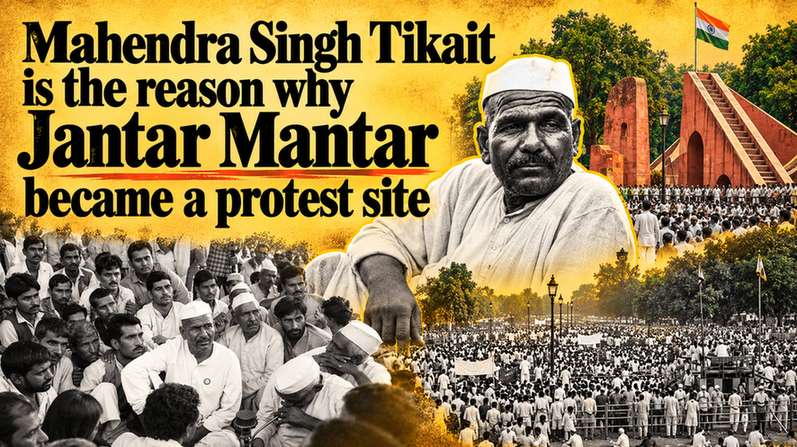
The man behind emergence of Jantar Mantar as a protest site is the peasant leader Late Mahendra Singh Tikait.
Tikait’s occupation of the Boat Club with Bharatiya Kisan Union (BKU) affiliated peasants in 1988 became the watershed that forced the government to rethink where and how people could protest in Delhi. The evolution from Ramlila Maidan to Boat Club to Jantar Mantar reflected the Indian state’s gradual attempt to regulate, contain and domesticate public dissent.
Ramlila Maidan: The city as a political stage
In the first decades after Independence, Delhi had no permanent protest address. Political meetings took place at Ramlila Maidan, the Red Fort area, Parade Ground, Patel Chowk and sometimes near Parliament.
Ramlila Maidan became especially important. Ronald Vivian Smith documented its growth as a major venue for political meetings. Gandhi, Nehru and Sardar Patel addressed crowds there. Lal Bahadur Shastri used the Maidan in 1965 to popularise “Jai Jawan, Jai Kisan”, while Jayaprakash Narayan addressed a huge gathering there in 1975 shortly before the Emergency.
The relationship between protest and the government began to change as demonstrations increasingly sought proximity to Parliament.
The 1966 anti-cow-slaughter agitation was an important turning point. Protesters attempted to move towards Parliament, violence followed and police firing took place. Restrictions on demonstrations around Parliament subsequently became stricter.
The government learnt that controlling the location of protest is as important as controlling the protest itself.
Boat Club: Protest moves towards power
By the 1970s and 1980s, the Boat Club lawns near India Gate had emerged as one of the capital’s principal political gathering places.
The site was close to Parliament, ministries and Rajpath. A demonstration there was not merely a public meeting but a visual reminder to those in power that protesters had arrived at their doorstep.
According to The Indian Express, tens of thousands of students gathered at Boat Club during the Emergency, while a later farmers’ rally brought more than 100,000 people. The area could become a temporary political encampment.
Then came the Tikait.
1988: The Tikait moment
The rise of Mahendra Singh Tikait was part of the wider expansion of farmers’ movements during the 1970s and 1980s. Scholars including Tom Brass, Ashutosh Varshney and Dipankar Gupta studied how rural groups increasingly organised around prices, electricity, irrigation, credit and agricultural policy rather than remaining dependent on established political parties.
In western Uttar Pradesh, Tikait led Bharatiya Kisan Union (BKU) emerged as a powerful organisation. Gaurang R. Sahay’s study of the BKU emphasises the importance of traditional institutions such as the panchayat, kinship and village networks in sustaining mobilisation.
In September 1988, the BKU decided to take its demands to Delhi. On 25 October, farmers began occupying the Boat Club area.
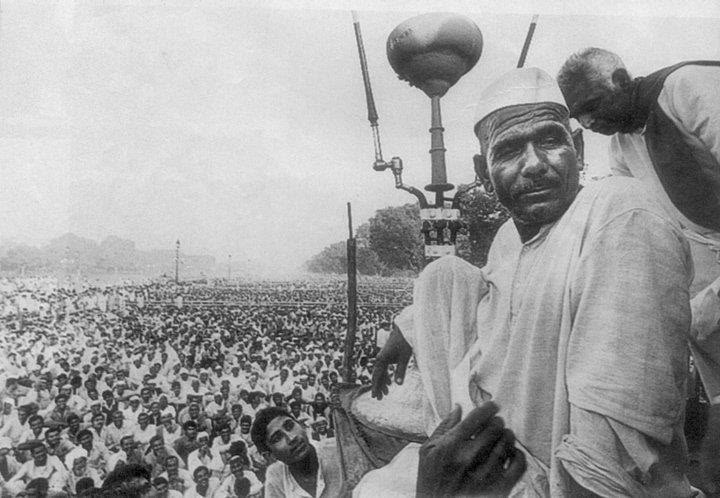
(Mahendra Singh Tikait at Boat Club in October 1988)
The scale was extraordinary. Estimates put the crowd at nearly five lakh farmers. Tractors, bullock carts, charpoys, cattle, cooking fires and hookahs transformed central New Delhi into something resembling a gigantic rural camp.
For several days, the farmers had occupied the symbolic centre of the Indian government. They were sitting beside the institutions of government.
The Rajiv Gandhi government eventually reached an understanding with the protesters, and the occupation ended on 1 November.
During a Lok Sabha debate on 3 November 1988, BJP MP C. Janga Reddy declared:
“An agitated farmer means an agitated nation.”
The episode demonstrated the political power of a mass occupation of central Delhi as well as its disruptive potential.
For the administration, the lesson was straightforward that the Boat Club could not be allowed to become another permanent encampment.
From Boat Club to Jantar Mantar
This is where Tikait enters the history of Jantar Mantar.
A Delhi High Court judgment records the Delhi Police’s explanation of the change. Demonstrations had earlier been permitted at Boat Club, but a late-1980s demonstration had resulted in Rajpath, Rafi Marg and other major roads being blocked “for many days”.
The authorities subsequently decided that demonstrations would no longer be allowed at Boat Club and offered Jantar Mantar instead. Larger gatherings were directed towards Ramlila Maidan.
The judgment does not name Tikait. Nevertheless, contemporary accounts and later historical writing repeatedly treat the 1988 farmers’ occupation as the critical late-1980s event behind the transformation.
Jantar Mantar was still close enough to Parliament to give a protest political significance. But unlike the Boat Club, it could not accommodate hundreds of thousands of people. Its narrow roads and limited space made it far easier to monitor and barricade.
The government had not abolished protest but redesigned its geography.
Jantar Mantar becomes a protest institution
By the 2000s, this improvised arrangement had become an established feature of Delhi’s political life.
Delhi Police told the High Court that between January 2006 and 15 August 2010, Jantar Mantar witnessed 5,491 demonstrations, rallies and processions and 13,118 dharnas and hunger strikes with permission.
Jantar Mantar was no longer an alternative to the Boat Club but became a part of democratic infrastructure.
Farmers, workers, students, pensioners, activists and political organisations brought their grievances to the same stretch of road. Its proximity to Parliament supplied the symbolism while police regulation supplied the limits.
The very contradiction defined the site.
Jantar Mantar was simultaneously a space of dissent and a space designed to contain dissent.
Anna Hazare turns a regulated site into a national symbol
In 2011 Anna Hazare began his hunger strike for a strong Lokpal.
Television turned the relatively small protest ground into a national stage. Images of crowds, candles, banners and hunger strikes at Jantar Mantar were broadcast throughout India.
A site that had emerged partly because the state wanted to prevent another Boat Club occupation had itself become one of the most recognisable symbols of Indian protest.
The pattern was repeated by many later movements, reinforcing Jantar Mantar’s place in the political imagination.
When the protest site itself became contested
The contradiction eventually became a legal problem.
In 2017, residents complained about noise, sanitation and prolonged demonstrations. The National Green Tribunal ordered that protests at Jantar Mantar cease and suggested alternatives.
The tribunal also noted that there was no clear formal government notification permanently declaring Jantar Mantar a protest site.
The dispute eventually reached the Supreme Court in Mazdoor Kisan Shakti Sangathan v. Union of India.
In its 2018 judgment, the Court balanced the right to peaceful protest against residents’ rights to public order and a peaceful environment. It described peaceful protest as “crucial in a democracy”, while accepting that reasonable regulation was legitimate.
The legal dispute exposed the same tension that had produced Jantar Mantar in the first place.
Governments want protests to be visible, but manageable.
Protesters often want it to be disruptive enough to attract attention.
The Tikait connection
Mahendra Singh Tikait showed Delhi what could happen when a mass movement occupied the Boat Club. He brought the countryside into the heart of Lutyens’ Delhi. The administration responded by moving much of organised dissent to a smaller and more controllable space.
That space was Jantar Mantar.
Tikait did not establish Jantar Mantar as a protest site but he did help make the political conditions for it.
The journey from Ramlila Maidan to Boat Club to Jantar Mantar was a journey in the changing relationship between citizens and government.
At Ramlila Maidan, the crowd could be enormous.
At the Boat Club, the crowd came dangerously close to power.
At Jantar Mantar, dissent was given an address and a boundary.
So, the story of Jantar Mantar begins not with a hunger strike there, but with thousands of tractors and nearly half a million farmers occupying the Boat Club in October 1988.
In that sense, Mahendra Singh Tikait was the men who made Jantar Mantar possible.
(The ideas expressed by the author are personal to him and do not represent the Heritage Times)