
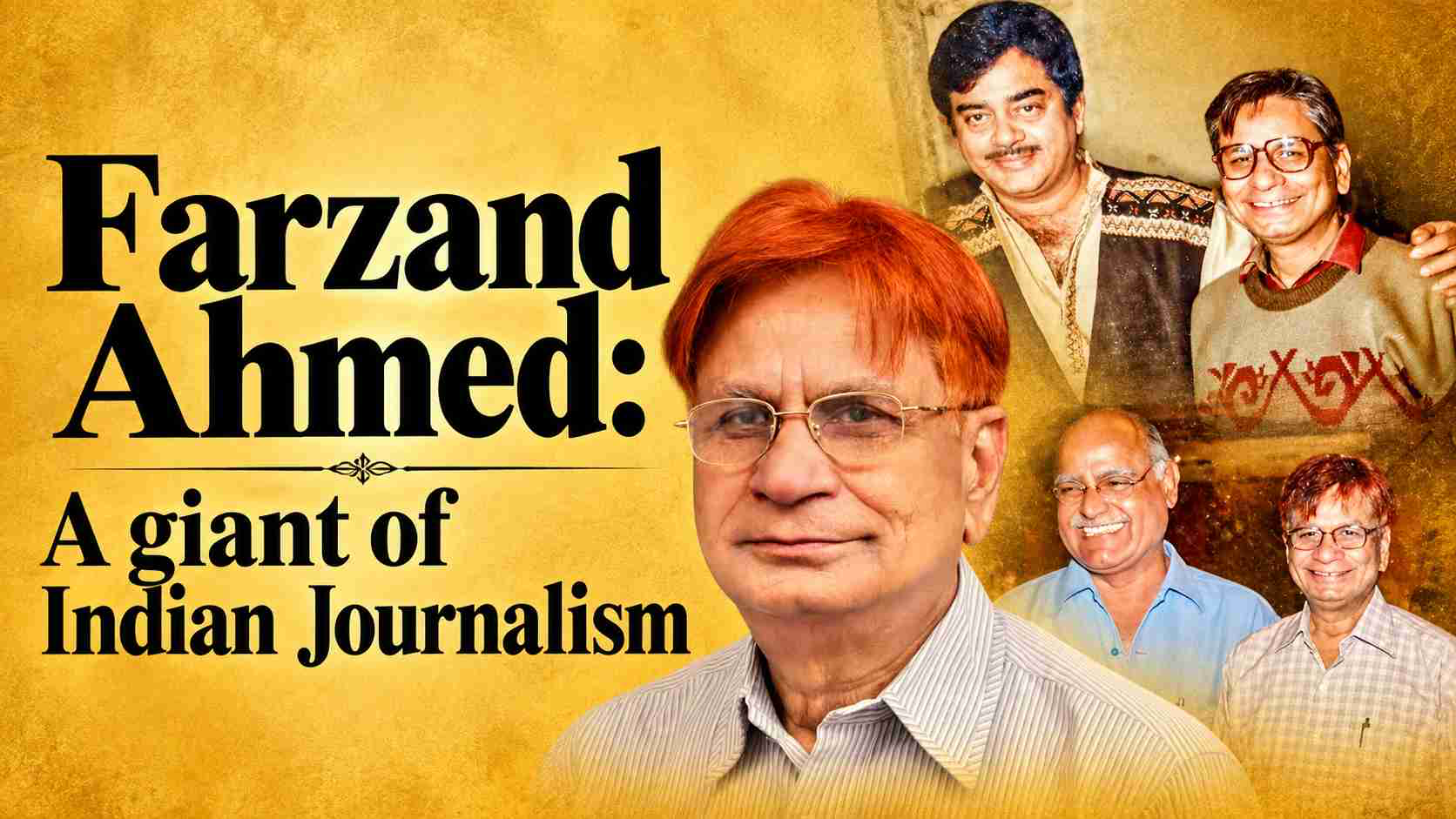
Farzand Ahmed: The Fearless Bihar Journalist Who Chose Resignation Over an Apology
Standing Up to CM Karpoori Thakur: A Resignation on Principle
It was early 1979 and Karpoori Thakur was the chief minister. One day he was very furious. The Amrit Bazar Patrika had published a front page story about him.
Thakur was so angry with certain parts of the story. He immediately called the editor of Patrika in Calcutta (Kolkata) and asked him to remove the reporter at once. The editor asked his newly appointed correspondent to immediately go to the CM and apologise.
The reporter, whose only a few stories had so far been published in Patrika, refused to see Thakur least to seek his forgiveness. He preferred to send his resignation. The resignation letter was accepted immediately.
The reporter was Farzand Ahmed. Quitting the few days’ short employment with Patrika he went back to UNI. The teleprinter and signboard were also removed from his residence in the next few days.
The ‘Sunday’ Magazine Byline Mix-Up
I knew him before that and had once met him. In the late 70s when I was in college my first story in English was published in Sunday Weekly news magazine, then edited by M J Akbar. The story titled “Bhutto’s Third Eye” was about the espionage network of Pakistan PM Zulfikar Ali Bhutto against his rivals which helped eliminate many of them.
I did the story on the basis of various reports in Urdu newspapers and magazines of Pakistan with documentary evidence which were regularly coming to my elder brother.
Ahmed’s colleagues in UNI and journalist friends thought that the article was written by Farzand Ahmed and the byline was misspelt as Faizan Ahmad. He tried his best to convince them it was not him but another person, the younger brother of his friend Rizwan Ahmad, a prominent Urdu journalist.
When they refused to be convinced, he took me to the UNI office where he introduced me to his friends.
The UNI Adda and Patna’s Golden Era of Journalism
Very soon Farzand formally joined India Today, then a fortnightly news magazine, after quitting Patrika, in May 1980. But his association or attachment with the UNI continued. Every evening he would go to Fraser Road office of the UNI which was then a favourite adda of senior journalists like P K Krupakaran, Durga Nath Jha, Arun Sinha, Hemendra Narayan and many more as well as prominent politicians like Abdul Gafoor, Kamalnath Singh Thakur, Lakshmi Sahu, Saryu Rai and occasionally visited by Dr Jagannath Mishra.
Then bureau chief of UNI D N Jha heavily depended on Ahmed for his reports which he would file much before being flashed by the rivals of UNI. While bureau members and others enjoyed booze, Ahmed would draw on his filtered cigarettes and glass of tea while pushing his two fingers on Remington and tearing typed pages from the teleprinters’ left over paper roll.
“The Dev Anand of Journalism”
Celebrated journalist and my colleague Sankarshan Thakur, who passed away last year, wrote a beautiful obit describing Farzand saheb as “an ever smiling and affable man, never unwilling to help and guide, an engaged, informed, and keen journalist, and, date I say, barely a shave away from the cut of a charming celluloid hero of the retro years. He reminded me of Dev Anand sometimes, the way he smiled that clean smile of his.”
Mentorship and Core Philosophy: “Fact is Sacrosanct”
I got the privilege to remain close with Farzand for almost 40 years and spent good times in his company, he would take me to various places within the state on his assignments and helped me a lot to understand the nitty and gritty of journalism. When he would sit and start typing his stories on a typewriter, he would give me the page to minutely read and “correct if there’s anything wrong” or just count the words.
When the stories were filed through telegram the words were counted. I know he did this only to facilitate me to have a little understanding of the facts. He always believed in the philosophy of “Fact is sacrosanct and the rest is fiction.”
“An Institution Within India Today”
In India Today he covered Bihar, UP, Delhi, Odisha, West Bengal, Northeastern states and Nepal.
Impressed by his dedication, sincerity, hard work and honesty India Today Editor-in-chief Aroon Purie called Farzand Ahmed “An institution within India Today”, that was a rarest compliment to a journalist, weightier than any award.
Beyond Journalism: A Legacy in Public Service
After leaving India Today, where his last designation was Deputy Editor, a good 40 plus years of association, he was appointed Information Commissioner with Bihar State Information Commission by the state government. During his brief stint of hardly two years he passed several orders and punished erring government officers which are regarded as historical.
Later on the UP government appointed him Adviser to Vocational Education & Skill Development department by the end of 2013 where he served till he breathed his last on October 2, 2016.
(The ideas expressed are personal to the author and do not represent The Heritage Times)
https://www.heritagetimes.in/farzand-ahmed-journalist-from-bihar-at-india-today


